
The Execution Gap: Why Your Business Has a Strategy Problem Disguised as a People Problem
You’ve read the books. You’ve attended the masterminds. You have a Notion board full of quarterly goals, a Slack channel dedicated to “big ideas,” and a Google Doc with your three-year vision mapped out in impressive detail.
And yet, somehow, the same five tasks keep falling through the cracks every single week.
Client onboarding is inconsistent. Follow-ups happen late—or not at all. The CRM hasn’t been updated since last quarter. And that SOPs project you swore you’d finish in January? Still sitting in draft mode.
If this sounds familiar, you’re not alone. And you’re not failing. You’re experiencing what we call The Execution Gap—the distance between what you know your business needs and what actually gets done on a daily basis.
What Is The Execution Gap?
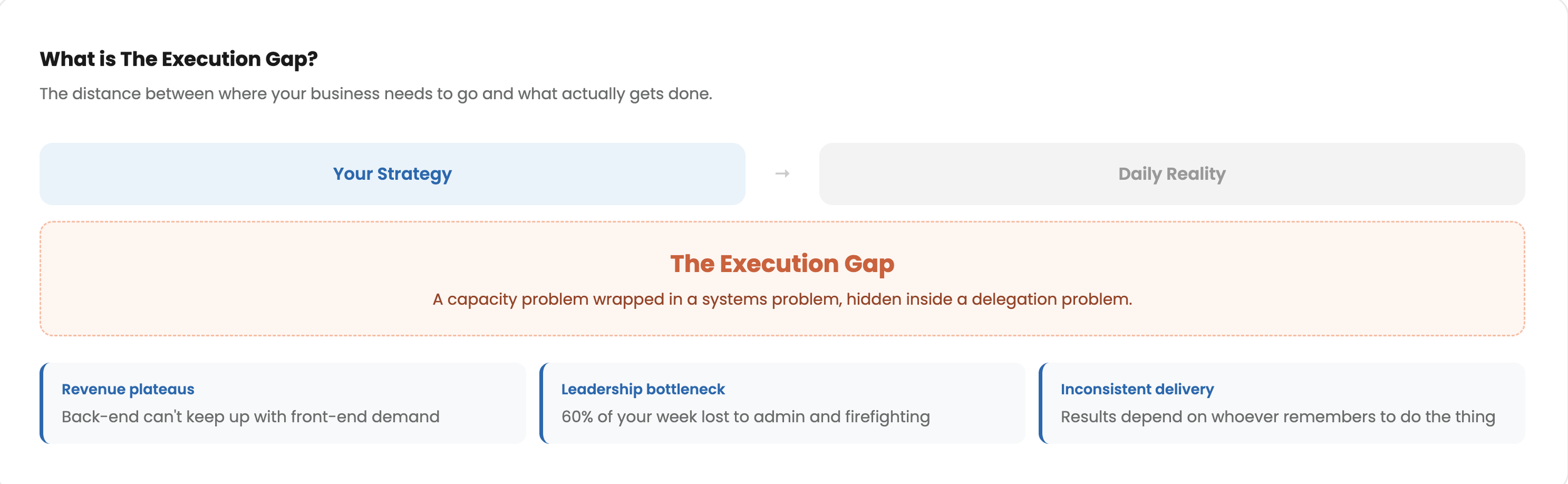
The Execution Gap is the space between strategy and reality. It’s what happens when a founder or leadership team has clarity on where the business should go but lacks the operational capacity to get there consistently.
It’s not a knowledge problem. It’s not even a motivation problem. It’s a capacity problem wrapped in a systems problem, hidden inside a delegation problem.
And it shows up in predictable ways:
Revenue plateaus despite strong demand and pipeline activity. You’re turning away work or delivering it late because the back-end can’t keep up with the front-end.
Leadership time hemorrhages into operations. You started this business to lead, sell, and create—but you’re spending 60% of your week on admin, coordination, and putting out fires.
Team members underperform not because they’re incapable, but because no one owns the recurring workflows that keep the engine running. Tasks get assigned. They don’t get owned.
Client experience suffers because delivery depends on whoever remembers to do the thing, rather than a repeatable system that ensures it happens every time.
Why Traditional Hiring Doesn’t Fix It
Most founders try to solve The Execution Gap by hiring. They post for an office manager, a project coordinator, or—most commonly—a virtual assistant. And for a while, it helps. Someone else is answering emails and scheduling meetings.
But within 90 days, the same problems resurface. Why? Because task completion isn’t the same as operational ownership.
A virtual assistant can check off your to-do list. But who’s building the to-do list? Who’s identifying the bottlenecks before they become emergencies? Who’s designing the workflows that prevent the same problem from happening next month?
The Execution Gap doesn’t close with more hands. It closes with operational intelligence—someone who understands your business deeply enough to own the recurring systems that keep it running without your constant involvement.
The Real Cost of the Gap
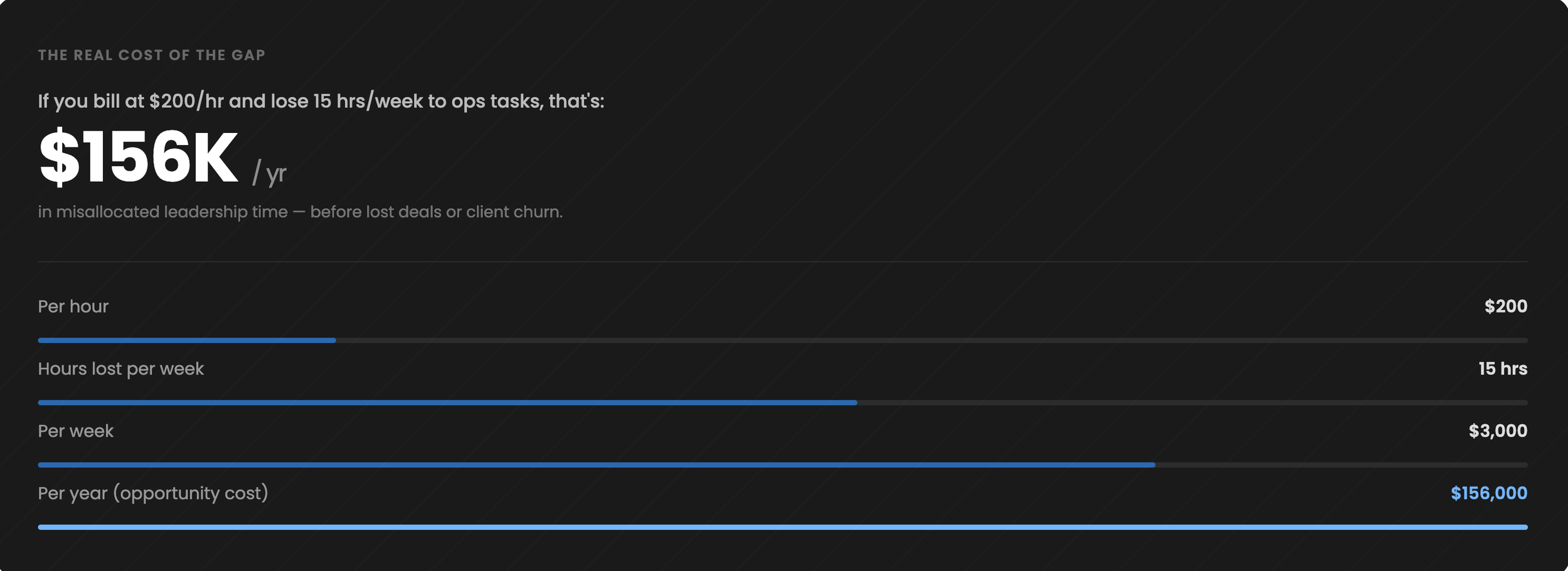
Let’s put numbers to it. If you’re a founder billing at $200/hour and you’re spending 15 hours a week on operational tasks that someone else could own, that’s $3,000 per week in misallocated leadership time. Over a year, that’s $156,000 in opportunity cost—before accounting for the deals you didn’t close, the clients you didn’t retain, or the strategic moves you didn’t make.
The Execution Gap doesn’t just slow your growth. It caps it. You can’t scale what you can’t systematize, and you can’t systematize what no one owns.
What Closing the Gap Actually Looks Like
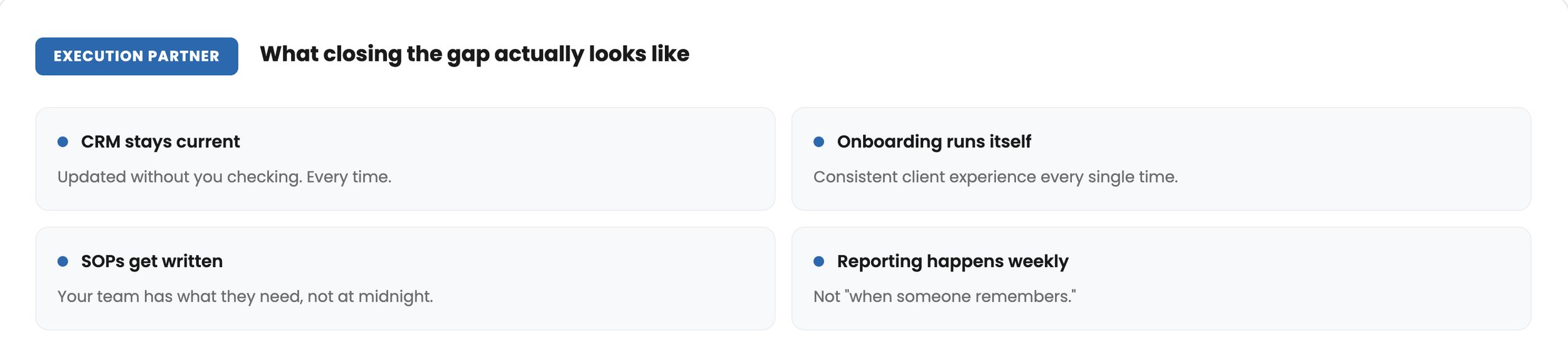
Closing The Execution Gap requires a fundamentally different approach than traditional hiring or outsourcing. It requires an execution partner—someone who doesn’t just do tasks but owns outcomes.
An execution partner embeds into your business. They learn your systems, your rhythms, your pain points. They take recurring workflows off your plate entirely—not by asking you what to do each morning, but by proactively owning the operational backbone of your business.
That means your CRM stays updated without you checking. Your client onboarding runs the same way every time. Your team has the SOPs they need without you writing them at midnight. Your reporting happens weekly, not “when someone remembers.”
It’s the difference between having help and having an operational backbone.
The Bottom Line
If you’re a founder sitting on a great strategy with inconsistent execution, the answer isn’t to work harder, hire faster, or lower your standards. The answer is to close The Execution Gap with an embedded partner who owns the systems that keep your business running.
Because your business doesn’t need more ideas. It needs the operational capacity to execute the ones it already has.
Ready to close The Execution Gap? Schedule a free Discovery Call with Elite Remote Partners and find out exactly where your business is leaking time, revenue, and momentum.
