
5 Signs Your Nonprofit Needs an Execution Partner, Not Another Consultant
If you’re a nonprofit executive director, you’ve probably hired at least one consultant in the past two years. Maybe a fundraising consultant. Maybe someone for strategic planning. Maybe a DEI advisor or a communications specialist.
And chances are, they delivered a beautiful report. A thorough assessment. A comprehensive set of recommendations with timelines, KPIs, and implementation frameworks.
That report is probably sitting in a shared drive right now, 80% unimplemented.
This isn’t a criticism of consultants. Many are excellent at what they do. The issue is that nonprofits don’t typically struggle with knowing what to do. They struggle with having the capacity to do it.
Here are five signs your nonprofit needs an execution partner, not another strategy engagement.
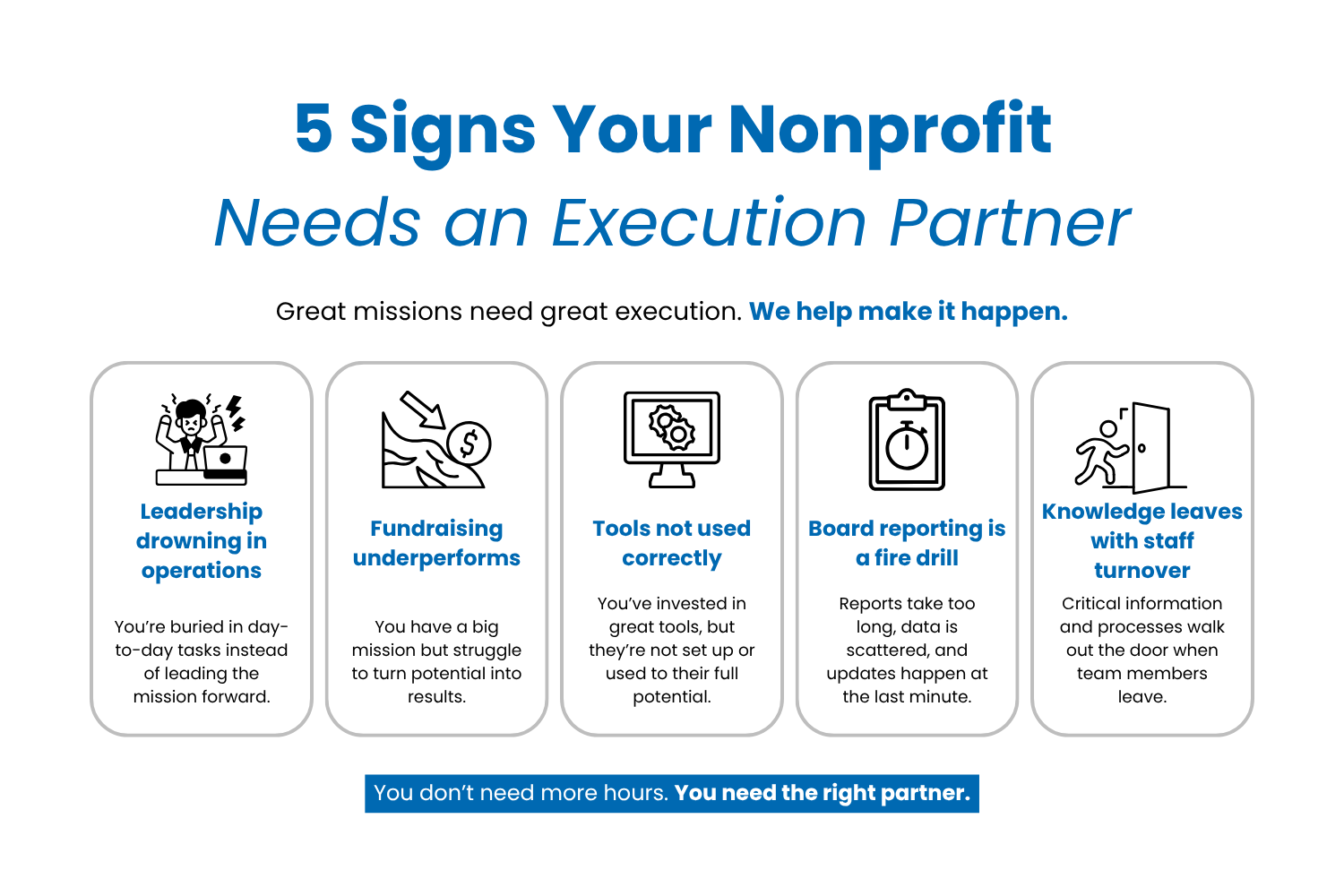
Sign 1: Your Leadership Team Is Drowning in Operations
Your ED is managing the donor database. Your development director is also handling event logistics. Your program manager is writing social media posts between running programs.
When leadership time is consumed by operational execution, two things happen: strategic work doesn’t get done, and operational work gets done poorly. Not because people are incapable, but because everyone is doing two jobs.
An execution partner takes the operational load off leadership’s plate entirely. They own the recurring workflows—donor communications, CRM management, grant calendar tracking, board meeting prep—so your team can focus on mission-critical leadership work.
Sign 2: Fundraising Campaigns Underperform Due to Execution, Not Strategy
You have a strong case for support. Your donors believe in your mission. Your annual appeal letter is compelling. But your year-end campaign still underperformed because follow-up emails went out late, donor segments weren’t cleaned, the acknowledgment letters took three weeks, and the matching gift reminders never happened.
This is an execution failure, not a strategy failure. The plan was right. The implementation was inconsistent.
An execution partner ensures every touchpoint in your fundraising calendar happens on time, every time. They manage the operational mechanics of campaigns—segmentation, scheduling, acknowledgments, reporting—so your development team can focus on relationship-building and major gift cultivation.
Sign 3: You’ve Implemented New Tools That Nobody Uses Correctly
You invested in Bloomerang. Or Salesforce Nonprofit Cloud. Or Monday.com for project management. The consultants helped you set it up. Training was provided. And six months later, half the team has reverted to spreadsheets because no one is maintaining the system.
Technology only works when someone owns it operationally. Not the IT person who set it up. Not the consultant who recommended it. Someone who uses it daily, maintains data integrity, trains new staff, and ensures it’s actually serving the organization’s needs.
An execution partner becomes your systems owner. They don’t just use your tools—they manage them, optimize them, and make sure your team actually benefits from the investment you made.
Sign 4: Board Reporting Is a Monthly Fire Drill
Every month—or every quarter—the same scramble happens. Someone is pulling numbers from three different sources, manually building a board deck, and staying late the night before to make it look presentable.
Board reporting should be systematic, not heroic. The data should flow. The format should be templated. The process should take hours, not days.
An execution partner builds and owns the board reporting workflow. They create templates, establish data pipelines, and produce reports on schedule—so your leadership team shows up to board meetings prepared, not exhausted.
Sign 5: You Keep Losing Institutional Knowledge When Staff Turns Over
Nonprofits have notoriously high turnover. And every time someone leaves, they take with them the way things work. The undocumented process for grant reporting. The donor preferences no one wrote down. The event timeline that only lived in someone’s head.
An execution partner doesn’t just do the work—they document it. They create and maintain the SOPs, process maps, and operational manuals that make your organization resilient to turnover. When someone leaves, the knowledge stays.
The Shift Nonprofits Need to Make
The nonprofit sector has a consulting addiction. When something isn’t working, the instinct is to bring in an expert to diagnose the problem and recommend solutions. But for many organizations, the diagnosis isn’t the issue. It’s the implementation.
An execution partner fills the gap between strategy and reality. They don’t give you more recommendations. They make sure the recommendations you already have actually get done—consistently, systematically, and without burning out your team.
Your mission deserves more than good intentions and great plans. It deserves great execution.
Is your nonprofit stuck between strategy and execution? Schedule a free Operations Diagnostic with Elite Remote Partners. We’ll identify the exact workflows draining your leadership team’s capacity—and show you how to fix them.
