
Why Your Virtual Assistant Isn’t Working (And What You Actually Need)
You did the right thing. Your plate was overflowing, so you hired a virtual assistant. Maybe through an agency. Maybe a freelancer from Upwork. Maybe a recommendation from your mastermind group.
For the first few weeks, it felt like magic. Someone else was handling your inbox, scheduling your calls, and updating your spreadsheets. You could breathe again.
Then reality set in.
The VA needed constant direction. They completed tasks, but only the ones you explicitly assigned. If you forgot to tell them something, it didn’t get done. If the process changed, they didn’t adapt. If something unexpected happened, they froze.
You went from doing the work yourself to managing someone doing the work. Your time freed up by 20%, but your mental load actually increased.
Sound familiar? You’re not the problem. The model is.
The Fundamental Flaw in the VA Model
Virtual assistants are designed around a simple premise: you tell them what to do, and they do it. This works beautifully for founders who already have clean systems, documented processes, and clearly defined workflows. If your operations are already organized, a VA can execute within that structure.
But most founder-led businesses between $500K and $10M don’t have that. They have operations held together by the founder’s memory, a patchwork of tools, and a lot of improvisation.
In this environment, a VA doesn’t reduce complexity. They add a layer to it. Now you’re not just managing operations—you’re managing a person who’s managing operations. The bottleneck doesn’t disappear. It just gets an assistant.
Task Completion vs. Operational Ownership
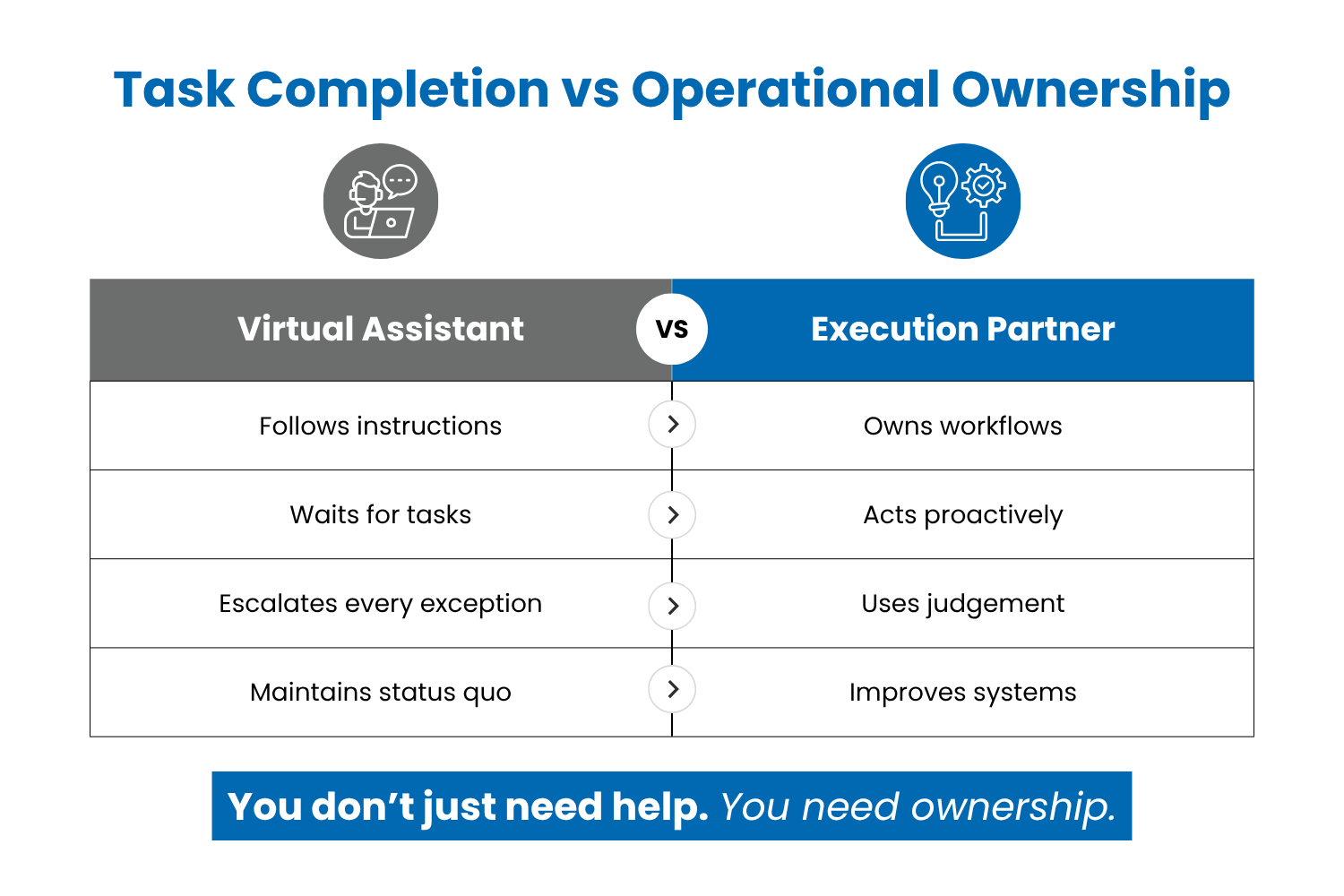
This is the distinction most founders miss, and it’s the most important one:
Task completion means someone does what you tell them. You think, they act. The cognitive load stays with you.
Operational ownership means someone owns a workflow end to end. They think, decide, act, and report. The cognitive load transfers.
When you hire a VA, you get task completion. When you hire an execution partner, you get operational ownership.
Here’s what that looks like in practice:
VA approach to client onboarding: You create a checklist. You assign the VA each step. They complete the steps you listed. If a step is missing, it gets skipped. If the client has a unique situation, the VA asks you what to do.
Execution partner approach to client onboarding: Your partner takes ownership of the entire onboarding process. They audit the current workflow, identify gaps, build an improved system, execute each onboarding end to end, adapt for edge cases using judgment, and continuously refine the process based on client feedback and team needs.
In the first model, you saved some time. In the second, you eliminated an entire category of work from your plate permanently.
Five Signs You’ve Outgrown the VA Model
1. You spend more time creating task lists than the tasks would take. If managing your VA has become its own job, the model is broken.
2. Nothing runs without your input. If you take a day off and things stall, you don’t have help—you have a dependent.
3. Quality is inconsistent. Because the VA follows instructions rather than understanding intent, output quality varies wildly.
4. You’ve cycled through multiple VAs. If you’re on your third or fourth VA, the issue isn’t the people. It’s the model.
5. Your operations feel more fragile, not less. Adding help should make your business more resilient. If it’s making it more fragile, something’s off.
What to Look for Instead
If you’re ready to move beyond the VA model, look for a partner—not just a provider—with these characteristics:
They embed into your business. They learn your tools, your clients, your team dynamics, and your operational rhythms.
They own workflows, not tasks. They don’t wait to be told what to do. They proactively manage recurring operational systems.
They exercise judgment. When something unexpected happens, they handle it—or escalate intelligently, with context and a recommendation.
They improve your systems over time. An execution partner doesn’t just maintain the status quo. They identify inefficiencies and make your operations better, month over month.
This isn’t about finding a better VA. It’s about upgrading to a fundamentally different operating model—one built on ownership, not instructions.
Ready to upgrade from task completion to operational ownership? Book a free consultation with Elite Remote Partners and see the difference an execution partner makes.
