
From Chaos to Systems: Building an Operational Backbone for Your Growing Business
Here’s a test. If you took two weeks completely off—no email, no Slack, no “just checking in”—what would happen to your business?
If the answer is anything other than “it would run fine,” you don’t have a business with systems. You have a business with hustle. And hustle doesn’t scale.
Building an operational backbone—the layer of systems, processes, and ownership that makes your business run without you as the engine—isn’t optional at a certain stage. It’s survival.
What an Operational Backbone Actually Is
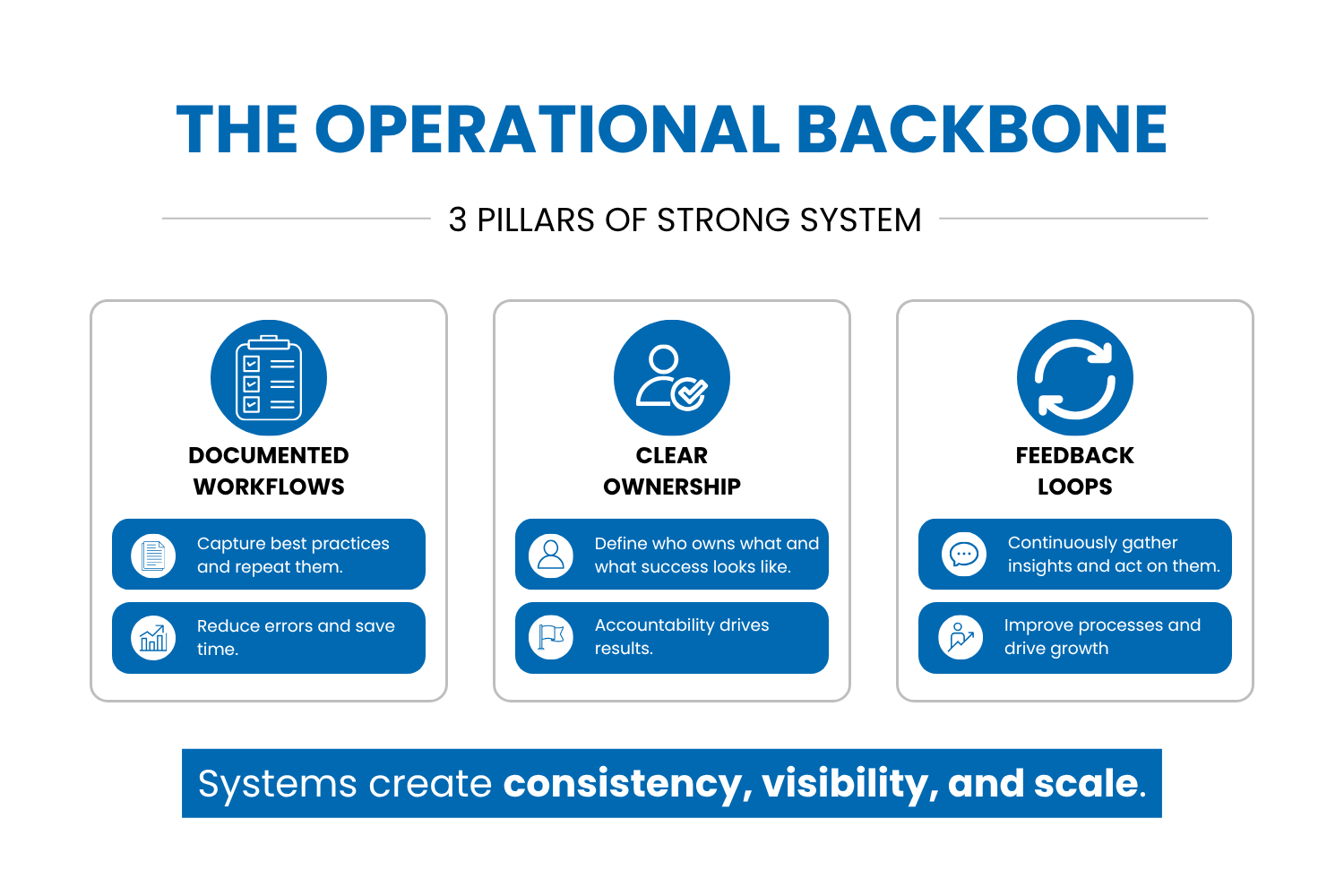
An operational backbone isn’t a fancy project management tool or a wall of SOPs. It’s the interconnected system of workflows, ownership assignments, and communication structures that ensure your business delivers consistently, no matter who’s in the room.
It has three components:
Documented workflows: Every recurring process in your business has a clear, accessible document that describes how it works. Not a novel—a reference. Something a new team member could follow in their first week.
Clear ownership: Every workflow has a named owner—not a team, not “everyone,” not “me when I get to it.” A specific person who is responsible for that workflow running correctly.
Feedback loops: Systems for tracking whether workflows are running as designed, flagging when they’re not, and improving them over time. Without feedback loops, your operational backbone degrades.
The Five Workflows Every Growing Business Should Systematize First
You don’t need to systematize everything at once. Start with the five workflows that create the most chaos when they break.
1. Client Onboarding
First impressions compound. A smooth, professional onboarding experience sets the tone for the entire relationship. A chaotic one creates anxiety that never fully resolves.
Your onboarding workflow should include: welcome communication, tool/platform access setup, kickoff call scheduling and agenda, initial information gathering, project timeline creation, and internal team briefing. Every new client should experience this identically, every time.
2. Financial Operations
Invoicing, payment tracking, expense management, and financial reporting. These aren’t exciting, but when they break, everything breaks. Late invoices mean late payments. Untracked expenses mean surprises at tax time. Missing financial reports mean you’re flying blind.
Systematize the rhythm: when invoices go out, when follow-ups happen, when reports are produced, and who owns each step.
3. Content and Marketing Operations
If your business relies on content—social media, email marketing, blogs, newsletters—the production workflow needs to be systematized. Content that depends on someone remembering to post is content that doesn’t go out. Build a content calendar with clear deadlines, approval steps, and publishing protocols.
4. Team Communication and Reporting
How does information flow in your business? If the answer is “through me,” you’re the bottleneck. Systematize team communication with structured check-ins, clear reporting formats, and defined channels for different types of communication.
Not everything is a Slack message. Not everything is a meeting. Define which channel serves which purpose, and stick to it.
5. Client Delivery and QA
However you deliver your service—whether it’s a product, a deliverable, or an ongoing engagement—the delivery workflow needs checkpoints. Who reviews work before it goes to the client? What’s the approval process? How are revisions handled? What’s the escalation path when something goes wrong?
Consistent delivery builds trust. Trust builds retention. Retention builds revenue. It all starts with the system.
How to Build These Systems When You’re Already Overwhelmed
The irony of operational improvement is that the people who need it most are the least equipped to do it. You’re too busy running the business to build the systems that would make running it easier.
This is where most founders stall. They know they need systems. They start documenting. They get through one or two processes before something urgent pulls them away. The documentation sits unfinished. The next quarter arrives. Nothing has changed.
There are two realistic paths forward:
Path 1: Carve out dedicated time. Block four hours per week—non-negotiable—for operational improvement. Focus on one workflow at a time. Document it, assign ownership, set up the feedback loop. Move to the next one. This works, but it’s slow and requires discipline most overwhelmed founders can’t sustain.
Path 2: Bring in an execution partner. An execution partner can audit your current operations, identify the highest-impact workflows, build the documentation, establish ownership, and create the feedback loops—while you keep running the business. This is faster, more sustainable, and produces better results because the partner brings operational expertise you don’t have to develop yourself.
The Payoff
A business with an operational backbone is a different animal. It’s calmer. More predictable. More profitable. Clients have better experiences because delivery is consistent. Team members perform better because expectations are clear. And the founder—finally—gets to lead the business instead of running it.
You didn’t start your business to manage spreadsheets and chase invoices. You started it to build something meaningful. An operational backbone gives you the space to do that.
Ready to build your operational backbone? Elite Remote Partners helps founder-led businesses transform from chaos to systems in 90 days. Book your free Operations Diagnostic and let’s get started.
