
The Real Cost of Doing Everything Yourself
Let’s talk about the most expensive employee at your company: you.
Not expensive because your salary is high. Expensive because every hour you spend on operational tasks is an hour not spent on revenue-generating activities. And when you run the numbers, the gap is staggering.
The Opportunity Cost Equation
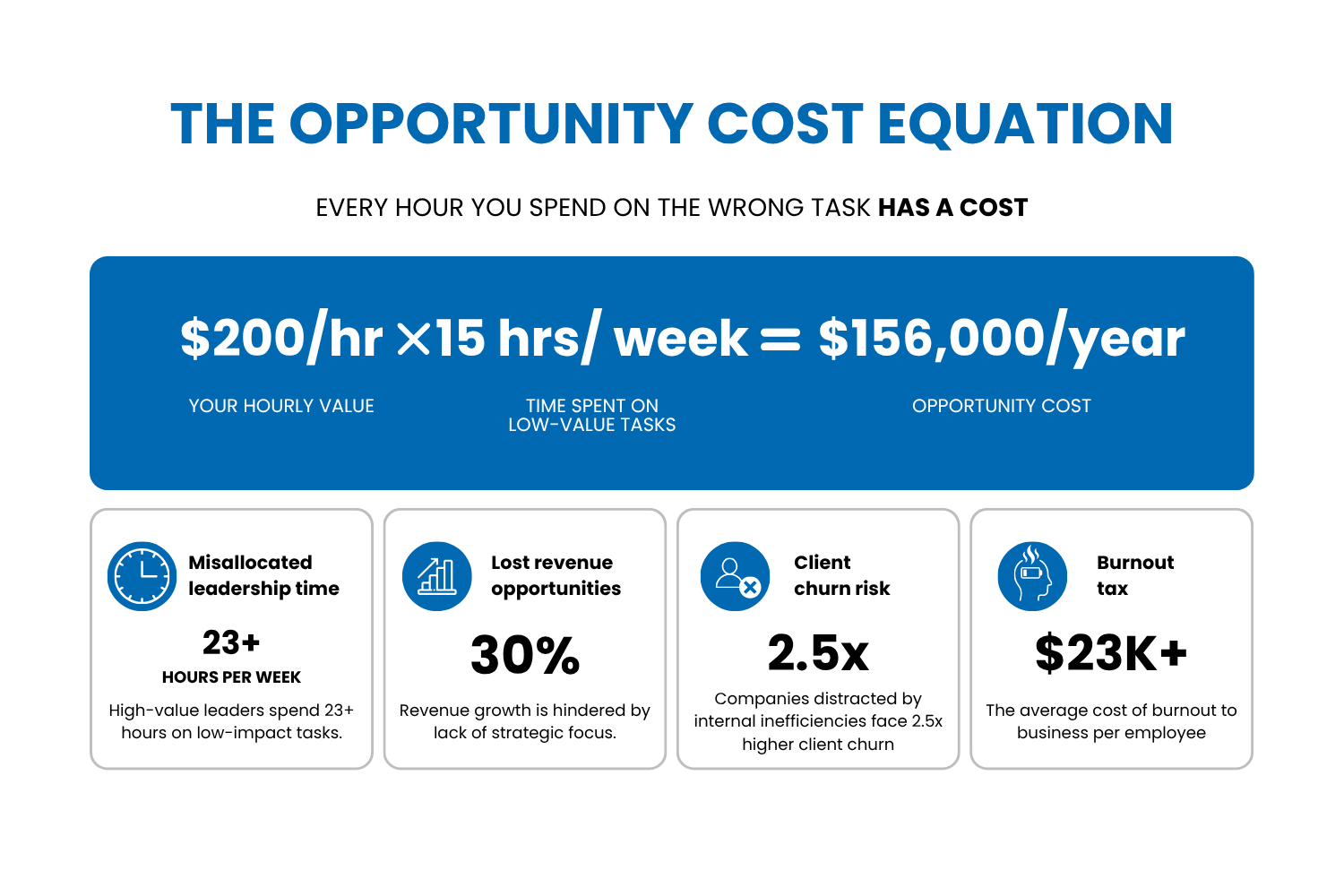
Here’s a simple framework. Take your effective hourly rate—the revenue you generate per hour when you’re doing the highest-value work in your business. For most founder-led businesses in the $500K-$10M range, that number falls between $150 and $500 per hour.
Now track how many hours per week you spend on operational tasks: email management, scheduling, CRM updates, invoice follow-ups, project coordination, team management, tool maintenance, and all the other unglamorous work that keeps the lights on.
For the average founder, it’s 15-25 hours per week. Let’s be conservative and say 15.
At $200/hour, that’s $3,000 per week in misallocated time. Over a year: $156,000.
That’s not what you’re spending. That’s what you’re losing.
The Hidden Multipliers
But the opportunity cost equation only captures the direct cost. There are multipliers that make the real number much higher.
The Revenue You’re Not Generating: Every hour spent in operations is an hour not spent on business development. If you close one additional $50K client per quarter because you had time to pursue it, that’s $200K in new annual revenue.
The Clients You’re Losing: Inconsistent delivery—the kind that happens when a founder is stretched too thin—drives churn. If operational breakdowns cost you even two clients per year at $30K each, that’s another $60K.
The Team Performance You’re Suppressing: When the founder is the bottleneck, the whole team slows down. Projects wait for your approval. Decisions wait for your input. Your team’s potential is throttled by your bandwidth.
The Burnout Tax: Founder burnout leads to poor decisions, reduced creativity, and eventually—for many—the desire to quit. The cost of a burnt-out founder isn’t measurable in dollars. It’s existential.
What the Math Actually Says
Let’s add it up conservatively. Direct opportunity cost: $156,000. Lost new revenue: $200,000. Client churn: $60,000. That’s $416,000 in annual cost—and we haven’t even quantified the productivity drag on your team or the burnout factor.
Now compare that to the investment in an execution partner. For a fraction of that number, you get someone who owns the operational workflows consuming your time, who maintains and improves your business systems, who ensures consistent delivery without your constant oversight, and who gives you back 15-25 hours per week to spend on what only you can do.
The ROI isn’t marginal. It’s transformational.
Why Founders Still Resist
If the math is this clear, why do founders keep doing everything themselves? Three reasons:
Identity: “I built this. I should be the one running it.” But running it and growing it are different jobs. At some point, you have to choose.
Control: “No one will do it as well as I do.” Maybe. But is “as well” the right standard? The right standard is “good enough to free you for higher-value work.”
Cost perception: “I can’t afford to hire someone.” You can’t afford not to. The cost of your time in operations is multiples of what an execution partner costs.
The Investment That Pays for Itself
Operational support isn’t an expense. It’s an investment with measurable returns: recovered leadership time, increased revenue capacity, better client retention, improved team performance, and reduced founder burnout.
Every week you wait, the meter runs. The question isn’t whether you can afford an execution partner. It’s how much longer you can afford to be your own.
Let’s run the numbers for your business.
