
How to Delegate Operations Without Losing Control
Every founder knows they should delegate more. It’s in every business book, every podcast, every mastermind session. “Delegate to elevate.” “Work on the business, not in it.” “You can’t do it all.”
And yet, most founders struggle with delegation—not because they don’t understand the concept, but because every time they’ve tried, something went wrong. The quality dropped. The client complained. The ball got dropped. And they ended up doing it themselves anyway, plus fixing whatever went sideways.
If this is your experience, the problem wasn’t delegation. It was how you delegated.
The Delegation Mistake Almost Everyone Makes
Most founders delegate tasks. They hand off individual actions: “Send this email.” “Update this spreadsheet.” “Schedule this meeting.”
This feels like delegation because someone else is doing the thing. But the thinking—the planning, the prioritizing, the decision-making—all stays with you. You’re still the operating system. You just have peripherals now.
True delegation isn’t about transferring tasks. It’s about transferring ownership of entire systems. And that requires a completely different approach.
The Four-Layer Delegation Framework
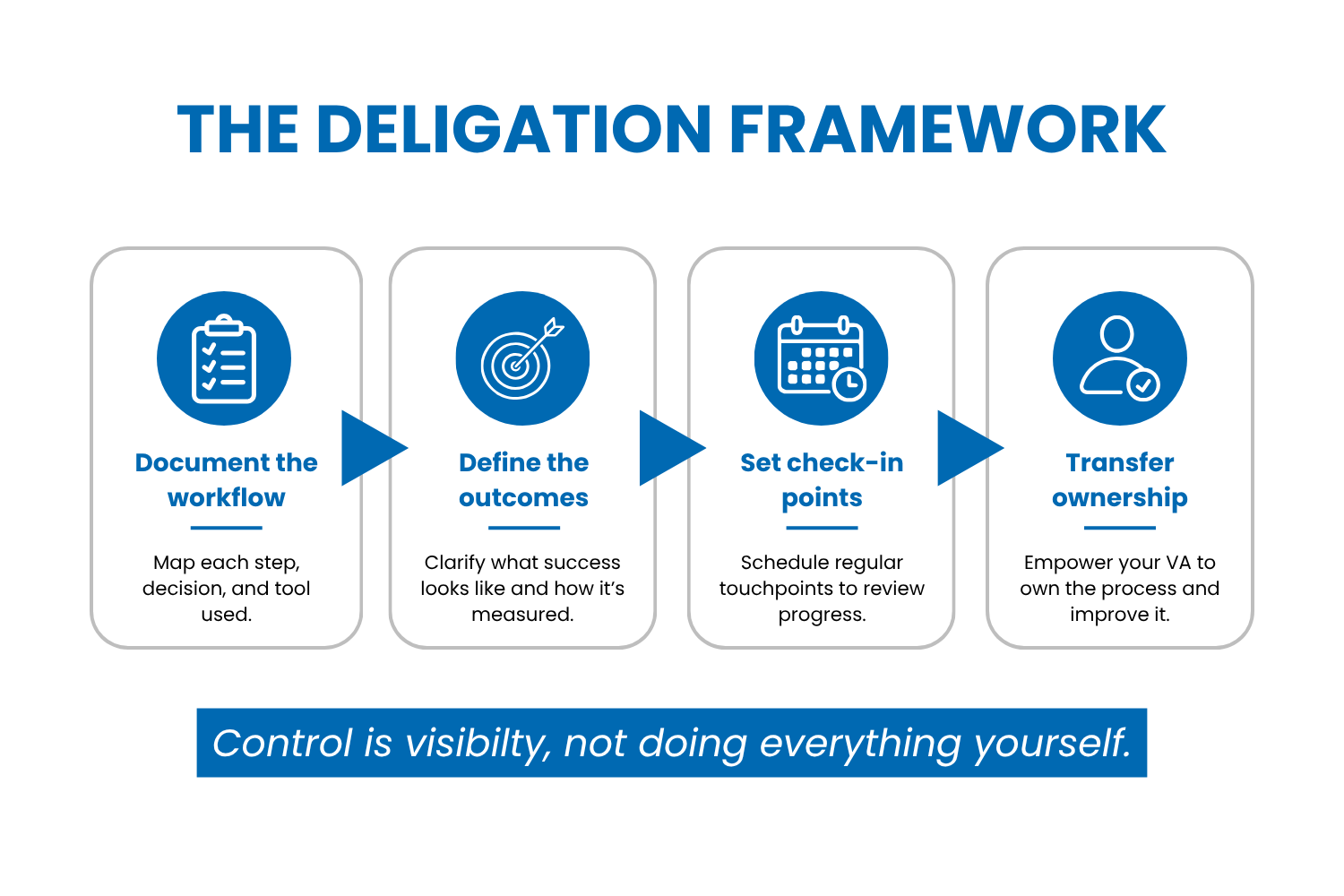
Layer 1: Document the Workflow
Before you delegate anything, map it. Not in exhaustive detail—just enough that someone could understand the inputs, steps, decision points, and outputs. This doesn’t have to be pretty. A Loom video, a bulleted list, or a simple flowchart is plenty.
The key question: “If I were unavailable, could someone execute this workflow from start to finish using only this documentation?” If not, keep refining.
Layer 2: Define the Outcomes
For each workflow you’re delegating, define what “good” looks like. Not the specific steps—the result.
For example: “Client onboarding is complete when the client has access to all tools, the kickoff call is scheduled within 48 hours, and the project timeline is loaded into Asana.” This gives the person ownership over how they get there, while you maintain clarity on where they need to end up.
Layer 3: Establish Check-In Points (Not Check-Ups)
The difference between a check-in and a check-up matters. A check-up is you looking over someone’s shoulder to make sure they’re doing it right. A check-in is a structured moment where they report on progress, flag risks, and ask for input if needed.
Set regular check-in rhythms—weekly is usually right—and resist the urge to intervene between them. If something goes slightly sideways, let the person course-correct. That’s how ownership develops.
Layer 4: Transfer Gradually, Then Fully
Don’t hand off everything at once. Start with one workflow. Let the person own it for two to four weeks. Review the outcomes—not the process. If the outcomes are where they should be, add the next workflow.
Within 60-90 days, you should have fully transferred the operational workflows that were eating your time. You’re still informed. You’re still in control of strategy and direction. But you’re no longer the person making sure invoices go out on time.
Why This Works Better with an Execution Partner
This framework works with any capable team member. But it works fastest and most reliably with an execution partner—someone specifically designed to receive operational ownership.
An execution partner doesn’t need to be trained from scratch. They come with operational fluency. They understand systems, workflows, and tools. They’re wired to own, not just to do. And they’re experienced in the exact type of work you’re trying to transfer: the operational backbone of a growing business.
The result is that Layer 4—the gradual transfer—happens in weeks, not months. And the quality of execution from day one is already at or near the level you’d produce yourself.
Control Isn’t About Doing. It’s About Knowing.
The founders who delegate well don’t let go of control. They redefine it. They stop defining control as “I do everything” and start defining it as “I know everything that matters.”
You don’t need to send the invoice. You need to know it was sent. You don’t need to onboard the client. You need to know the client is onboarded. You don’t need to update the CRM. You need to know the data is accurate.
That’s not losing control. That’s upgrading it.
Want help building a delegation framework for your business? Elite Remote Partners specializes in helping founders transfer operational ownership without sacrificing quality. Let’s talk.
