
The Capacity Trap: How Founder-Led Businesses Get Stuck Between $500K and $5M
There’s a specific growth stage that breaks founders. Not financially. Not emotionally—though that happens too. Operationally.
It happens somewhere between $500K and $5M in revenue. The business is successful enough to be real—real clients, real revenue, real responsibilities. But it’s not yet large enough to justify a full executive team, a COO, or a dedicated operations department.
You’re in the messy middle. And if you’re honest with yourself, you’re exhausted.
Welcome to The Capacity Trap.
What The Capacity Trap Looks Like
The Capacity Trap is what happens when a founder’s personal bandwidth becomes the ceiling for the entire business. Every decision flows through you. Every exception needs your input. Every new client means more of your time, not less.
At first, this felt like hustle. Now it feels like a prison you built yourself.
You know you need to delegate. You’ve tried. You’ve hired VAs, brought on contractors, even made a few full-time hires. But somehow, you’re still the bottleneck. The person everyone comes to. The one who catches the mistakes. The one who stays up late fixing what should’ve been handled hours ago.
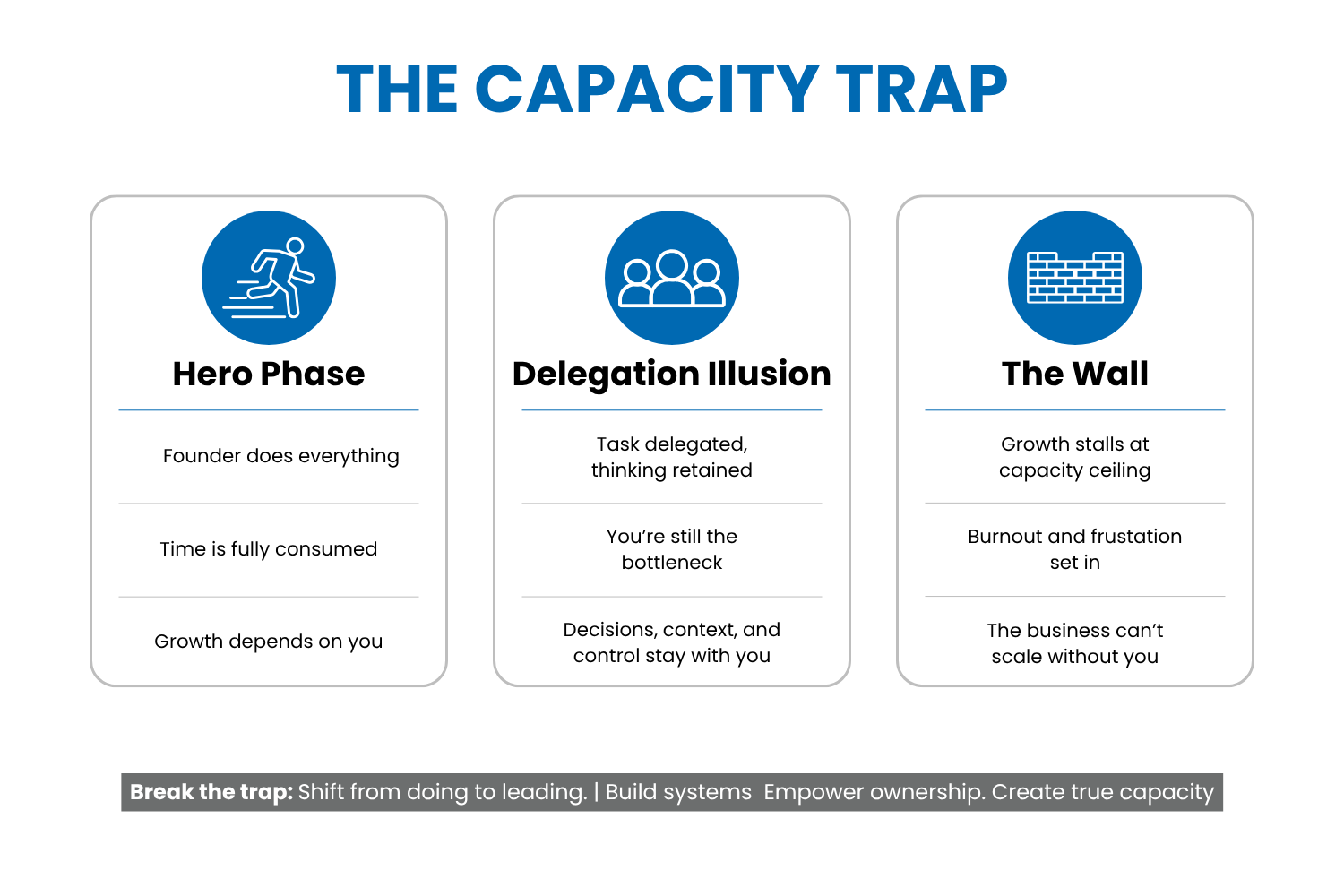
The Capacity Trap has three stages, and most founders don’t realize they’re in it until Stage 3.
Stage 1: The Hero Phase
You do everything because you’re the best at everything—or at least, you believe you are. Sales, delivery, operations, invoicing, client management—all you. It works because the business is small enough that one person can hold it all. Revenue grows because of your effort.
Stage 2: The Delegation Illusion
You bring on help, but you delegate tasks instead of ownership. You hand off to-do items but keep the thinking. You assign actions but retain the decisions. Your team does work, but you still manage every workflow mentally. Your calendar looks different, but your cognitive load hasn’t changed.
Stage 3: The Wall
Growth stalls. Not because demand dropped, but because you can’t take on more without breaking. You start saying no to opportunities—not because they’re wrong for the business, but because you physically cannot absorb them. Your revenue flatlines. Your energy craters. And you start wondering whether you even want to keep doing this.
Why The Capacity Trap Is So Hard to Escape
The cruelest part of The Capacity Trap is that the skills that built your business are the same ones keeping you stuck. You’re resourceful, detail-oriented, and driven. Those traits made you a great founder. But they also make you a terrible delegator.
You don’t trust easily. You see gaps others miss. You know that if something goes wrong, the client calls you—not your assistant. So you hold on. You check. You redo. You micro-manage because the cost of a mistake feels too high.
And every time you “delegate” a task and it comes back wrong, it confirms the narrative: no one can do it as well as I can.
But here’s what that narrative misses: the cost of doing everything yourself isn’t just your time. It’s every opportunity your business misses while you’re buried in operations.
Breaking Out: The Operational Shift
Escaping The Capacity Trap doesn’t require hiring an executive team or raising capital. It requires an operational shift—moving from founder-driven execution to systems-driven execution.
This shift has three components:
Identify recurring workflows. Most of what eats your time isn’t unique. It’s the same 15-20 operational tasks happening on repeat—weekly reporting, client onboarding, invoice management, content scheduling, CRM updates. These are systematizable.
Transfer ownership, not tasks. Stop telling people what to do each day. Instead, hand off entire workflows—end to end—to someone who can own them. The goal isn’t to check things off a list. It’s to never think about them again.
Embed operational intelligence. The person who owns these workflows needs to understand your business deeply enough to make judgment calls, flag risks, and improve processes without being told. This is where traditional VAs fall short—and where an execution partner changes the game.
What Life Looks Like on the Other Side
Founders who break through The Capacity Trap report the same experience almost universally: they feel like they got their business back.
Monday mornings aren’t dreadful anymore. They’re strategic. The inbox isn’t a disaster. It’s managed. Client delivery doesn’t depend on the founder remembering. It depends on systems that run whether the founder is in the office or on vacation.
Revenue starts climbing again—not because of more effort, but because leadership time is finally being spent on the activities that actually drive growth: business development, strategic partnerships, product innovation, and team leadership.
The Capacity Trap is real. But it’s not permanent. You just need the right operational partner to help you escape it.
Stuck in The Capacity Trap? Schedule a free Discovery Call with Elite Remote Partners and discover exactly where your business is leaking capacity.
